I have seen the Journal Entries application displaying a message when large Journal Entries are saved that states the remainder of the save will execute in the background. We have an API call on a table that is currently timing out and I’m wondering if we could have the same behavior trigger for the API call. Is there a setting that would allow for this?
I have found this pattern in the ProcessGenerateSalesOrderInvoice Logic Block and see that it is something that is explicitly coded. We will go with that approach for now.
The Background Operations field on an application definition has a value for Large data background save, also known as Asynchronous Save.
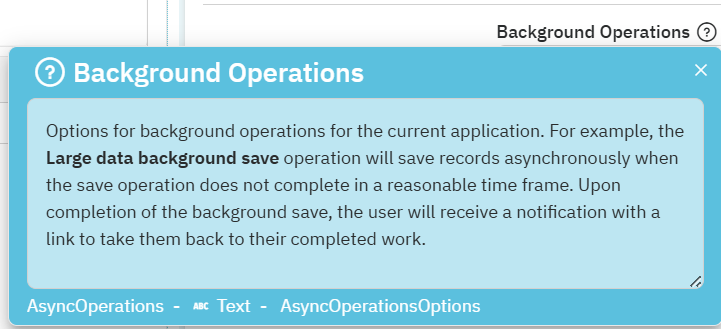
This is the field used to indicate that the save action should progress to the background on the API server after its processing exceeds a certain time limit.
I went looking at the PUT requests on a save from an application directly but could not find the information in the request payload. It might well be there but I don’t know exactly where it lives. It would likely be in the request labeled as AsyncOperationsor something similar.
That referenced logic has a hard-coded limit to process records in the background over a certain limit. If someone else knows how to perform that call, hopefully we can get another answer here.
Is that setting available at the table level? This timeout occurs on an inbound POST. So an application builder setting would probably not work?
As far as I know, that setting is only available on the Application definition and not related to the table.
I think we will continue pursuing a strategy similar to ProcessGenerateSalesOrderInvoice, but noting that something like what was mentioned above with AsyncOperations would be useful to have for tables/API calls.
Ross it correct in that via the Platform this setting is only available at the app level, but really it is about how your NATE container is committed. So you actually can use it via REST endpoint calls as well by sending the asyncSave flag = true in the request body when you commit your container.